The digital signage industry has grown beyond simple electronic posters. It now
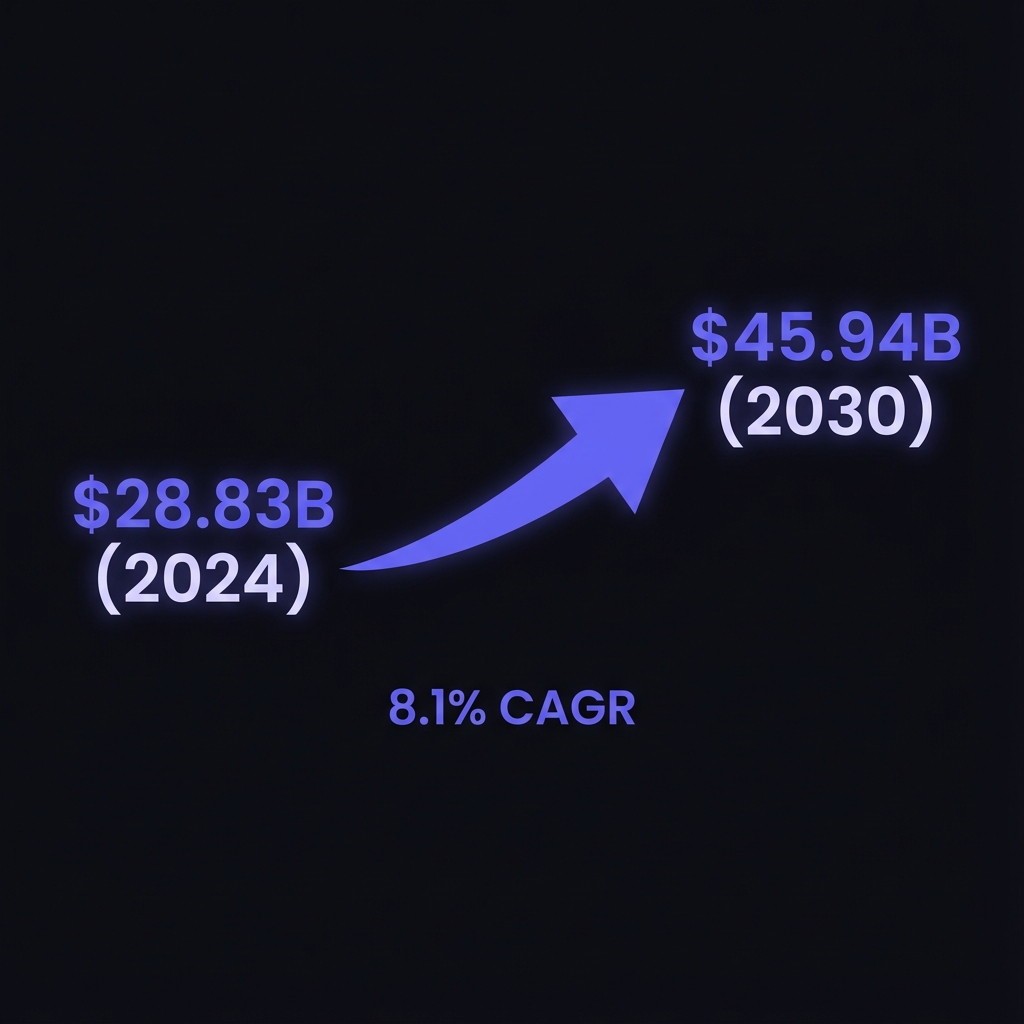
represents the 'fourth screen' in daily life — after TV, computer, and mobile. At nearly
$29 billion, the market has crossed from early adoption into mainstream necessity.
This growth rate outpaces the broader economy. It signals that digital signage is still
expanding, not a mature flat market. Driving forces: falling hardware costs, cloud-based
software making management easier, rising consumer expectations for digital in physical
spaces.
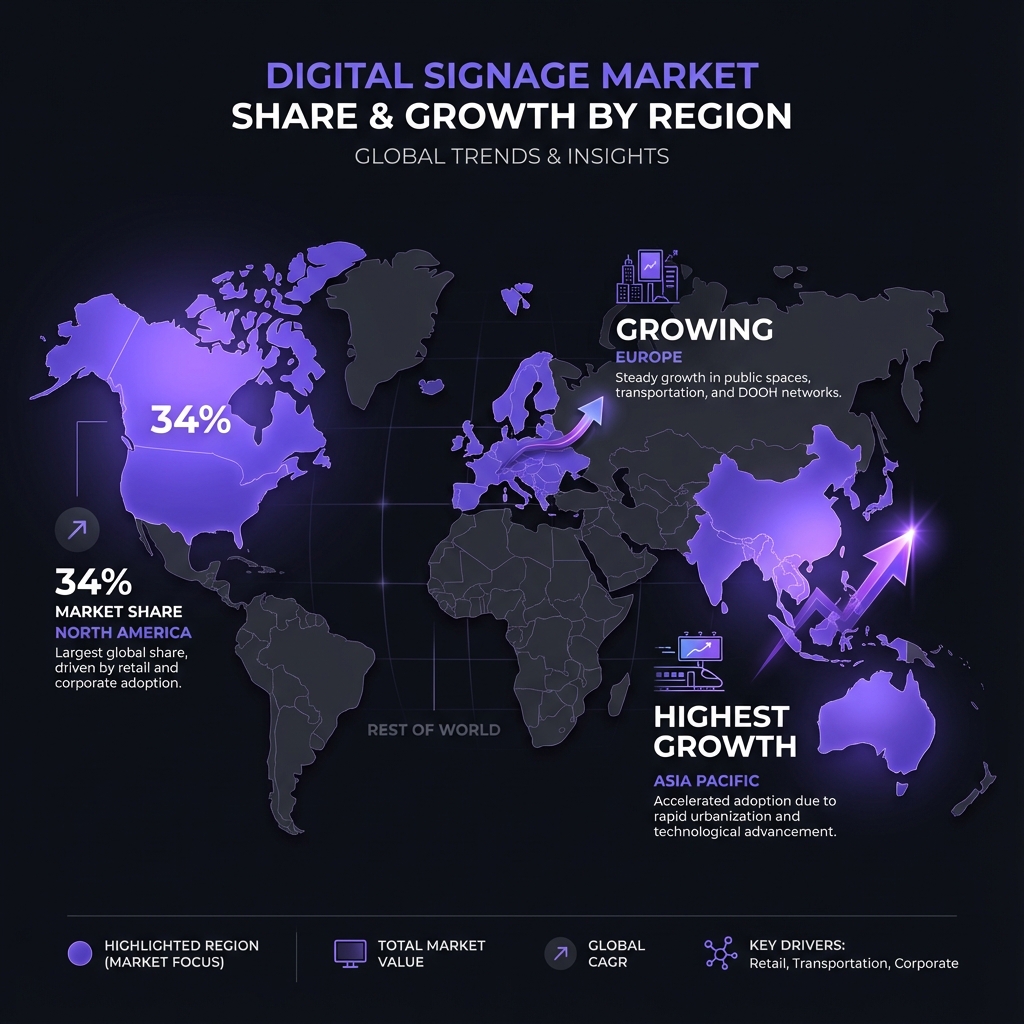
North America is the largest regional market. The current phase is 'replacement and
upgrade' — early adopters moving from 1080p to 4K, from on-premise to cloud.
Asia-Pacific is catching up fast with highest growth rates.
Hardware (displays, players, mounts) still dominates spending. But software is the growth
engine — 10.1% CAGR. Cloud-based CMS is replacing local installations. The industry is
shifting from one-time hardware sales to recurring SaaS revenue.
Not just 'brand awareness' — hard sales numbers. Retailers see 32% increase in actual
revenue after deploying digital signage. This comes from better product visibility,
dynamic promotions, and real-time pricing changes based on inventory or time of day.
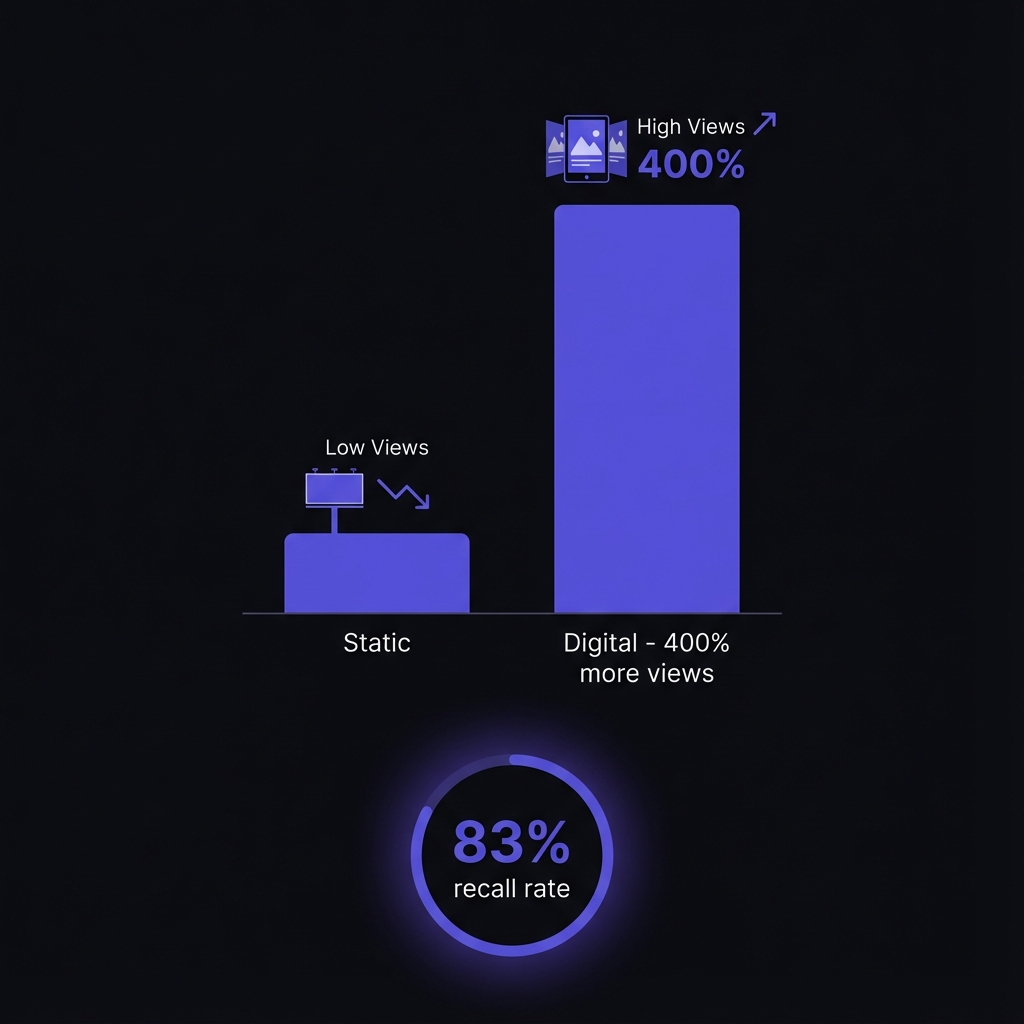
Human brains are wired to detect motion. Static signage fades into background noise.
Digital screens with moving content get 4x the attention. Documented via Intel's
eye-tracking study measuring actual viewer engagement.
Nearly double traditional advertising recall. When someone sees a message on a digital
screen, they're far more likely to remember it compared to print or static signs.
Valuable for both impulse purchases and building lasting brand awareness.
Related
400% more views than static
55% higher ad recall in retail vs other in-store media
In banking and healthcare, wait time is a satisfaction killer. Digital signage reduces
perceived wait by 35% — not actual wait time, but how long it feels. When people have
something to watch, time passes faster. Translates directly to higher satisfaction
scores.
Related
46% customer satisfaction improvement
88% of hospital patients find digital wayfinding helpful
8 out of 10 customers say they entered a store specifically because a digital sign caught
their attention. The sign isn't decoration — it's an active sales tool that brings
people through the door who otherwise would have walked past.
Most purchase decisions happen at the point of sale, not before. Nearly 3 out of 4
shoppers say in-store digital signage influenced what they bought. Unlike online ads
(which require a later action), in-store digital captures attention and converts
immediately.
Digital signage extends shopping time by 30%. More time browsing means more opportunities
to discover products and make purchases. The screen content acts as a 'retention anchor'
— giving shoppers reasons to stay and explore rather than making a quick exit.
Related
80% entered store due to signage
32% higher sales
19%Impulse purchase increase
Mvix Research
Triggers Unplanned Buying
Digital signage increases impulse purchases by 19%. The combination of motion, color, and
timely promotions catches shoppers' attention and triggers spontaneous buying decisions.
This is particularly effective for promotions, seasonal items, and upsells.
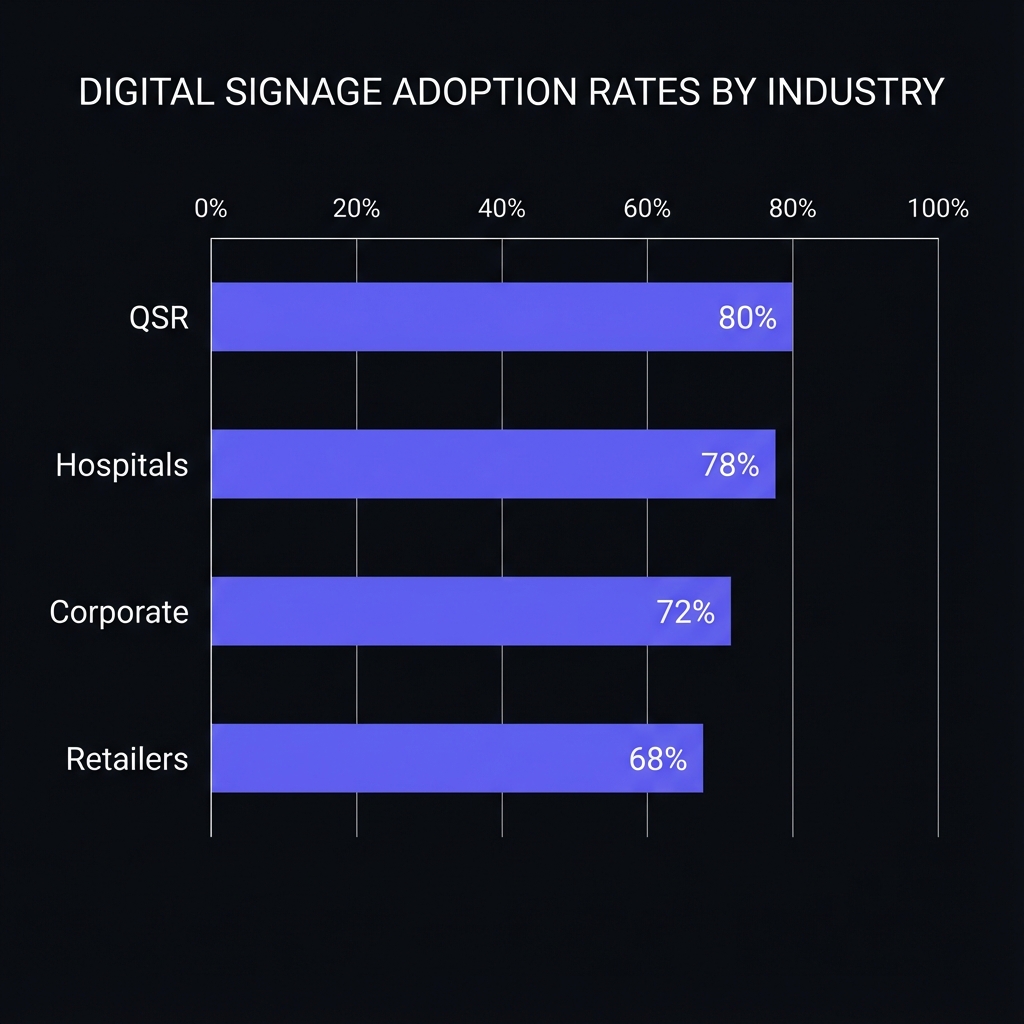
Digital menu boards are now standard in quick-service restaurants. Benefits: instant
price updates across all locations, time-of-day menu changes, promoting high-margin
items, easier compliance with nutritional labeling requirements.
Most hospitals now use digital messaging for wayfinding, patient communication, and
health education. It reduces staff interruptions ('Where is radiology?'), improves
patient experience, and helps deliver consistent health messaging.
Related
88% find wayfinding helpful
20% reduction in accident/illness rates from safety messaging
Company announcements on screens in break rooms, lobbies, and production floors reach
employees who never check email. For 'deskless' workers — manufacturing, logistics,
retail — this is often the only reliable way to communicate beyond a physical notice
board.
Related
27% employee engagement increase
25% higher productivity
56% plan to increase usage
Technology Trends
80%⚠️ Installations FAIL
Industry Survey
⚠️ Critical Warning
80% of digital signage installations fail to meet their business objectives. The reason?
Not hardware failure — content failure. Companies buy screens, display
static content for months, then wonder why results don't come. The "set it and forget
it" model doesn't work.
How to Avoid This
Define content strategy BEFORE buying hardware
Content loop should be 5-10 minutes
Update content regularly (not monthly — weekly)
Measure: track engagement, not just uptime
Related
53% of users plan to increase content spending
42% will use AI for content creation
71.5%LCD/LED share of US market
Mordor Intelligence
Still the Dominant Technology
LCD and LED displays dominate because they balance cost, brightness, and reliability.
OLED is growing fastest (9.9% CAGR) but from a smaller base. For most deployments,
LCD/LED remains the practical choice — proven technology with competitive pricing.
Programmatic buying brings online advertising efficiency to physical screens. Advertisers
buy screen time in real-time, target specific locations, times, demographics — then
measure results. Opens digital signage to smaller advertisers who couldn't negotiate
direct deals.
Programmatic DOOH is the industry's hottest growth area. It transforms screens from cost
centers (internal use) to profit centers (ad revenue). Generated $7.5B in 2024,
projected to reach $45.8B by 2034. Expected to account for 42% of all OOH ad spend by
2029.
Over 40% of new digital signage installations use 4K resolution. As screen sizes grow and
prices drop, 4K has become the baseline for professional deployments. Higher resolution
improves readability from distance and enables more sophisticated content designs.
Interactive digital signage is the fastest-growing segment. By 2030, the interactive
display market will reach $86 billion. This includes touchscreens, gesture control, and
mobile integration. Retail, hospitality, and wayfinding drive adoption as customers
expect self-service.
Related
Self-order kiosks standard in QSR
Gesture recognition gaining in healthcare
AR/VR integration emerging
60%Plan to invest in 2 years
Digital Signage Today
Strong Investment Pipeline
60% of businesses plan to deploy or expand digital signage within two years. The COVID-19
pandemic accelerated adoption as businesses needed contactless solutions and flexible
communication. Post-pandemic, the focus shifted to customer experience and operational
efficiency.
Retail is the biggest buyer of digital signage — and growing. Projected to reach $21.2B
by 2034 at 12.7% CAGR. Beyond sales lift, retailers see 24% higher foot traffic and 55%
better ad recall compared to other in-store media. Retail media networks are turning
stores into advertising channels.
Putting an item on the digital menu board with a highlight or animation increases its
sales by 15%. QSRs use this for high-margin items, limited-time offers, or overstocked
inventory. Digital menus also allow instant price changes and time-based menus.
Digital screens in offices, warehouses, and break rooms increase employee engagement by
27%. They share company news, celebrate achievements, display KPIs, and reach deskless
workers who don't see email.
The US market leads globally, growing to $12.92B by 2030. North America holds 34% of
global market share. The current phase is 'replacement and upgrade' — early adopters
moving from 1080p to 4K, from on-premise to cloud management.
Asia-Pacific is the growth engine. India is expected to have the highest LED growth
globally, driven by smart city initiatives. China drives volume with lower hardware
costs from local manufacturing.
Digital out-of-home advertising will more than double, from $20B in 2025 to $46B by 2032.
The shift to programmatic buying makes screens accessible to more advertisers. 55.9% of
DOOH growth over the next 5 years will come from in-store retail media.
Nearly half of all out-of-home advertising spend will go to digital screens by 2029.
Traditional billboards aren't disappearing, but growth is all digital. Programmatic
buying, better measurement, and real-time content updates make digital the preferred
format.
Methodology note: Statistics marked as "Industry Survey" or "Multiple Studies"
aggregate findings from vendor research and trade publications. We prioritize Tier 1 sources for
headline statistics. If you find inaccuracies or have updated data, please contact us.
❓ Frequently Asked Questions
Can I use these statistics in my content?
Yes. You can freely cite these statistics in blog posts, presentations, reports, and marketing
materials. We ask that you link back to this page as the source. Example: "According to SeenLabs
Research, digital signage captures 400% more views than static displays."
How often is this data updated?
We update this page quarterly. The last update was December 2025. Market research reports are
typically refreshed annually, so major changes (market size, CAGR) update once per year.
What is the global digital signage market size?
$28.83 billion in 2024, projected to reach $45.94 billion by 2030 at 8.1% CAGR (Grand View
Research). The US market alone is $9.07 billion.
What ROI can I expect from digital signage?
Retailers report an average 32% increase in sales. Digital displays capture 400% more views than
static signs and achieve 83% message recall rate. ROI varies by industry and implementation
quality.
Why do most digital signage installations fail?
80% of installations fail to meet objectives due to poor content strategy. Companies buy screens
but don't plan for regular content updates. Success requires: content strategy before hardware,
5-10 minute content loops, weekly updates, and engagement measurement.
What is programmatic DOOH?
Programmatic DOOH (pDOOH) allows advertisers to buy digital screen time in real-time, similar to
online ads. It's growing at 31.5% CAGR and expected to reach $45.8B by 2034. This transforms
screens from cost centers to potential revenue sources.
How much of OOH advertising will be digital by 2029?
44% of all out-of-home advertising spend will go to digital screens by 2029 (OAAA/StackAdapt).
Traditional billboards aren't disappearing, but growth is all digital.
📊
Get Full Report
Enter your details to download the complete Digital Signage Statistics 2025
report as PDF.